In the Fall of 2018, I took part in that year’s edition of KASA/MIX. Held biennially, KASA/MIX brings taiko-loving participants from around the world to Japan and to the Kodo Apprentice Centre in the beautiful mountains of Sado Island. Kodo is arguably the world’s most well-known and respected Japanese drumming group and has played a leading role in popularizing taiko drumming. In Japanese the word Kodo has two meanings : “heartbeat”, the primal source of all rhythm; and, “children of the drum”.
This is an account of my participation in KASA/MIX. It is an incomplete account. For one, uncharacteristically, I took no notes. I have had to rely on memory, official references, and the help of other participants and friends. Any factual errors are, of course, mine and mine alone. More importantly perhaps, KASA/MIX is a unique life experience. It is difficult to transcribe the experience into words. Yet, my attempt to do so is meant to help me process the experience, prolong the delight and joy I have felt throughout this adventure, encourage others to volunteer, and maybe provide some tips to those who are about to join the ranks of KASA/MIX graduates.

Taiko Beginnings
Some background information, as it may help set the stage. Like many taiko enthusiasts, my introduction to taiko was via a performance by Kodo (Vancouver, January 2011). I had never seen taiko performed live and had only a vague acquaintance with the art form. As it happened, just prior to the concert I bumped into a colleague who asked me if this was my first time. When I replied “yes”, I remember that his eyes lit up and he said “ You’re in for a treat; I never miss them whenever they come to Vancouver.” At the time I didn’t make much of the comment; I wasn’t yet sold on taiko. Sure, it was probably good. Maybe even very good. But let’s not get carried away.
The performance was, to say the least, mind-blowing. Not to discourage anyone from buying recordings of taiko, but of all music it is probably the one to which recordings do the least justice. A taiko performance has a physical component that I have never experienced with any other type of music. I do not think a live taiko performance, especially by a group like Kodo, can leave anyone unmoved. Much like KASA/MIX, it has to be experienced to begin to understand it.
Not having any musical background whatsoever, and however much I enjoyed Kodo’s performance, the idea to pick up bachi (taiko drumsticks) never crossed my mind. Other than a few sessions of flute in primary school (of which my most persistent memory is that the teacher told me – and a rare few others- to “just pretend to play” at the end-of-year recital), I have never learned (or attempted to learn) any musical instrument. I do not usually listen to music at home and rarely attend concerts. Suffice to say that music played a small, almost absent, role in my life.
Fast forward to 2016. Following a move to Calgary (Alberta), I decided I would A) be a better tourist in my own city (unlike Vancouver where I tried to cram 5 years’ worth of visiting into my last 6 months there); and, B) would challenge myself and try activities outside of my comfort zone. In the field of music, I desperately wanted to see Kodo perform again. Alas, Calgary is not on Kodo’s radar. A search of the Internet did however reveal that the local taiko group (Midnight Taiko, no longer the only performing taiko group in Calgary) was offering what it called “Taiko Hour”. As the name implies, “Taiko Hour” gives neophytes, a chance to learn about taiko and bang on the drums for an hour (Saturday, 13h00). This particular Taiko Hour was led by Paula Midori-Nieckar, then the Artistic Director for Midnight Taiko.
A word about Paula. Sometimes in life you are lucky enough to meet someone who is so clearly passionate about their hobby (sometimes beyond reason or regarding a hobby about which you have no interest in yourself), that you can’t help but find it fascinating and grow an interest of your own. That was Paula.
To my utter amazement, I showed some aptitude (measured in microcosmical terms but still). It was pleasant to discover that I wasn’t so completely uncoordinated or musically clueless. “Your heart is a taiko. All people listen to a taiko rhythm dontsuku-dontsuku in their mother’s womb. It’s instinct to be drawn to taiko drumming. In taiko, you can hear the sound through your skin” (Oguchi-sensei).
Taiko Hour was fun, but I never signed up thinking it would lead to more than an hour spent banging on drums and learning a little about taiko. Nor did the hour change my mind. And yet… Paula mentioned that she was starting a taiko class for beginners at Mount Royal University that night and would I like to come? It was a new programme, part of MRU’s community outreach. She invited me to sign up but I politely declined. Me? Learn to play an instrument? Preposterous.
And yet, a seed was planted. The idea worked its way through my brains (and heart?) over the weekend. By Monday night, I had decided I would sign up. I had already missed the first class but surely I could “catch up”. So I sent my information, forked over my hard-earned money, and became a registered member of MRU’s latest initiative. I showed up for class the following weekend. A little bit nervous but mostly excited at the prospect of learning taiko.
It was one of the least enjoyable time in my life. I had only missed one class but it felt as if I were 10 weeks behind (OK, maybe not 10 weeks. More like 15!!!). I felt lost, overwhelmed, embarrassed. I kept asking myself “What am I doing here?!?!” If I had felt I had done reasonably well during Taiko Hour now I was completely dépassé. The other students all had musical backgrounds (some played in ensembles, sometimes multiple instruments; one even taught music for crying out loud!). They seem to understand immediately what was being taught and imitate the sound and movements. Meanwhile I was still trying to remember what it was we had started class with (yoroshiku onegaishimasu). By the end of the hour long class I was on the verge of tears, grateful to escape, promising myself I would never return.
Yet, the following week I showed up. And again. And practiced hard (it’s one thing to suck at something; it’s another to be the one dragging down a team). And by the end, through sheer grit and determination, I managed to survive and even performed (for real) at the end of school year recital (take that my grade 3 music teacher whose name I have long since forgotten!). Still, by the end I had promised myself that I would survive this one course and then quit while I still had some dignity left.
So of course I signed up for the next course. And pretty much went through the same range of emotions (This is horrible. What am I doing here? I am NOT enjoying this). But somehow I survived (and even learned a thing or two and enjoyed a moment or two). And then signed up for the next course and so on. Gradually I became more comfortable with learning music (to be clear : I am still very much a novice and learn painfully slow. I just don’t feel as overwhelmed). Even public recitals aren’t as stressful as they first were (I was positively nauseous for hours prior to my first public performance; now I just feel a bit nervous).
Probably the single most important factor in my getting involved with taiko (and sticking with it) : the people. I feel very lucky to have joined a great group; they made learning and performing fun. I enjoy spending time with them. They are wonderful, fascinating people. I was happy to discover that, at large, the taiko community is very much the same. To be sure, there are still human dynamics in taiko community (read: human failings). But by and large, it is filled with wonderful, positive people, united by a love of taiko.

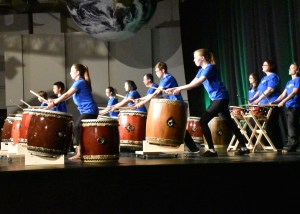
Signing up for KASA/MIX
So on to KASA/MIX. After two years of practicing taiko two hours a week (sometimes four), I felt I could greatly benefit from a more intensive taiko learning experience. I asked Paula if she knew of any programme, 5 to 20 days, where every day you would learn and practice taiko. She mentioned the deadline for KASA/MIX was coming up and suggested it might interest me. I checked online and Ooooh, 10 days in Japan. Sounds fun. Hey, it’s with Kodo. They’re pretty good (to put it mildly). Timing was good. Price was reasonable (in fact, I thought it was very reasonable and after KASA/MIX I thought it was a steal but I would never tell them). I watched the promotional video (https://www.youtube.com/watch?v=b7-zHY-qd6c). Multiple times. Loved it. Hmmm, sounds like it’s for serious taiko players. Ahhhh but why not? What do I have to lose?
I thought Paula was humouring me (as a 2 year novice, I did not feel I was prime KASA/MIX candidate). I was also sure that Paula would submit an application (and get selected). I would submit an application too (why not) but had zero expectation. It would be a learning experience. I filled out the forms, and then life continued. I told no one.
To my splendid amazement, I received an email informing me that I had been selected for KASA/MIX 2018 and would I like to confirm please? Ummmh? YES!!! Wow, I was floored. I immediately told Paula and asked her if she had gotten selected as well. She confided she had not submitted an application (Paula, next time you have to!). I was surprised to find out that not only was I the only one from Calgary, the only one from Alberta in fact, I was also the first.
September 1st
As with every trip I’ve ever done, the days leading to my departure for Japan felt like a marathon. So much to do… Frankly, by the time I left the house I was near exhaustion. And there were still a few things I had not managed to do (like learn some basic Japanese).
The flight from Calgary actually departed on the 31st of August and landed in Tokyo on September 1st, lasting just over 10 hours. Thankfully, I managed to sleep some of that. I watched a couple of movies : Isle of Dogs (it included both taiko and dogs so you know it had to be good), and Red Sparrow (which was very enjoyable). The in-flight meal was OK (my seat neighbour felt it was the worst food she had ever eaten and complained loudly; it did not come anywhere close for me. Try Air Maroc and tell me about it!). I was lucky to have an aisle seat so made regular trips to the back of the plane to stretch (and eat snacks).
Still, by the time we landed I was doing a fine imitation of a zombie. I absolutely, positively knew where KASA/MIX participants were supposed to meet before boarding the plane for Kanazawa. In fact, my knowledge was so approximate that I missed it and ended up in the secure zone (a small pre-boarding waiting area) with the realization that I had not made contact with the tour leaders (Yui and Yuta). After a moment of slight panic (great start to the trip: fail to meet the guides; that should make a good first impression) I convinced myself that if nothing else I was in the right spot to make my way to our destination and that the rest of the group would inevitably be on the plane (just look for the foreigners, I told myself). Eventually, I bumped one traveller I was sure was a KASA/MIX participant and she pointed me in Yui’s direction (Thank you Lisa!). I introduced myself to Yui (sounding just like someone who has been travelling for far too long). I have no recollection what Yui said but presumably she acknowledged and smiled (with a hint of relief). I feel reasonably confident that she did smile. Yui always smiled (in the picture associated to her online official bio, she has this big smile. All the other instructors and staff look very serious. Not Yui; she smiled. That’s Yui!).
While waiting for the plane I met Abena (from Washington, like Lisa), Ilka (whose name I mangled in my sleep stupor), Lee (who looked as sleepy as me), Lucy (from the UK) and a trio from Montreal (Daniel, Fanny, and Laeticia) whom I surprised by speaking French to them (yes, you can live in Alberta and speak French. Having grown up in Quebec helps). Some had just completed the Hachijo workshop (an option I could not take part in unfortunately because of work. Next time!). I think I met others as well but by that time my brains were pretty much shut down and occupied with a single thought : stay awake until you are on the plane, seated. Stay awake! STAY AWAKE! As it turns out, we boarded the plane and then stayed on the tarmac for another hour (ish?).
The flight from Tokyo to Kanazawa was memorable in that I slept very soundly for most of it. Logic suggests it was a short flight. Once landed we boarded a bus, and made our way to our hotel (TOYOKO INN Kanazawa), then got briefed on the next timing (Yui and Yuta were wise enough to keep things very simple at that point). I was delighted to learn we were not sharing rooms (I expected we would be two to a room). I promptly made my way to the 6th floor, found my room, and fell asleep. The bed was divine.
September 2nd
September 2nd was the first real start of our trip. Because of jet lag I was up early and lined up for breakfast in the lobby. There was a handball tournament in town (or a conventum of people who like to dress up as if they were handball players) so the lobby was jam-packed with teens, their coaches and parents. Breakfast was delicious and plentiful. Other participants trickled in and I met and re-met other participants (that’s when I discovered that Ilka was Ilka and not whatever my brains had decided it was at Narita).
By 09h15 all KASA/MIX participants and our two guides (the lovely Yui and Yuta) met in the lobby to discuss the days’ activities and some admin points. We had to write our names on our nametags, along with a Japanese translation. Ummmh, I don’t know my name in Japanese?!?! Thankfully, Yuta came to my rescue (not the only time during this trip). He wrote my name in small hiragana script on the back of my nametag and I reproduced it on the front, making it as big as I could. I completed my nametag by adding a smiley face. To make control easier, each participant was assigned a number (I was given number 14, which I thought was a nice number) and we practiced doing a head count (which went surprisingly well, considering). This would become a regular activity, whenever we boarded a bus or before we departed a location.
Our first stop was a visit of the Kenroku-en near Kanazawa Castle. Kenorku-en is one the Three Great Gardens of Japan. Early September was probably not the best time of the year to visit it but it was still stunningly beautiful. The visit was short (too short to fully appreciate the gardens) but we had another activity planned : making chopsticks. This was ridiculously touristy but just as ridiculously fun. Some showed real talent and imagination. Pat had a similar design as mine except hers was actually nicely executed (my chopsticks were fine, thank you very much).
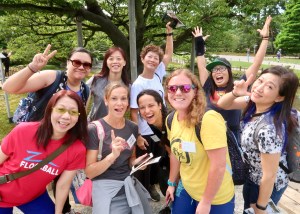
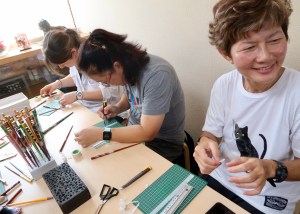
Chopsticks completed, we visited / had lunch in the local fish market. Prices for fruits were outrageous (by Canadian standards) but amazingly tasty. And the fish… Fresh fish is hard to beat. I shared lunch with the Montreal Connection : Daniel, Fanny, and Laetitia. The food was delicious and the company highly entertaining. The Montreal trio talked about their group (Arashi Daiko) and their experience on the Hachijo workshop (which only made me more sorry to have missed it).
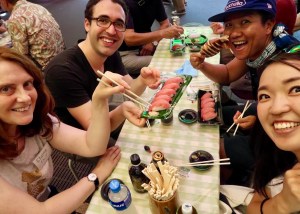
After lunch we boarded the bus (after a head count of course) and departed for the Asano factory. Rhet (from Australia) was my seat-buddy. He was awesome. I do not think I have ever met anyone as positive as Rhet. He just enjoyed everything to the max and was having such a great time. We shared a lot of silliness together (including coming up with all kinds of hare-brained money-making projects. How are you going to spend your first million Rhet?).
Arriving at the Asano factory was like arriving at the chocolate factory. Asano is not the only maker of drums but it is the biggest; many a taiko player owns (or dreams of owning) an Asano drum. For the record, my own drum was built by Toshi Kato (father of our guide Yuta. It’s a small world after all). I’m quite happy with my Kato drum.
Visiting the factory was fascinating (no photos please!). I had never seen so many drums, in so many stages of fabrication. The drums are made from whole trees and some were positively gigantic. There was a lot of machinery but human hands and touch are involved in each stage of fabrication. Our guide confessed that he did not play taiko, which surprised us. But I guess if you work at the chocolate factory, maybe you don’t eat chocolate.
Following a tour of the factory we got to build our own mini drums. The bodies were impressive (drums are carved from trees; the drums are hallowed and the interior wood is then carved again to make a smaller drum until there’s not enough wood to make a proper drum. The core of the tree is then turned into a mini drum. So the body of our mini drums were of the same wood used to make real, full-sized taiko drums). I thought that was neat. It was also bigger than I had expected. Poor Fanny and Daniel, who were planning an extended trip to Vietnam and Thailand after KASA/MIX were wondering how they were going to carry their latest souvenir. We also used real skins and rope to manufactured our own drum. It made for a very cool souvenir (despite eating up most of the space in my luggage dedicated to souvenirs. In the end, I would buy an extra suitcase in Tokyo to accommodate all my loot).
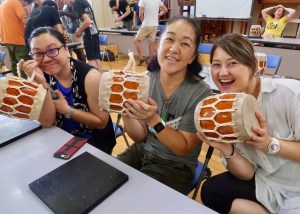
We then had a little bit of time to visit the museum and/or doing some shopping. I foolishly started with the shop. I say foolishly only because once I was done and went over to the museum, there was almost no time left before our next activity and wished I had picked more wisely. The museum was awesome (and included two gigantic drums that you could play). Those odaiko were massive; the size of a small bus. They also had all kinds of drums but I ran out of time. Learn from my mistake people.
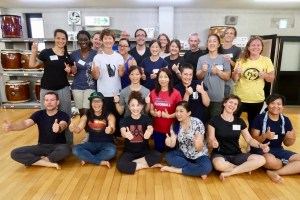
The icing on the cake followed : an odaiko workshop with Akemi Jige. A renowned taiko artist, Jige founded Hono Daiko -an all-female drumming group- in the late 1980s. She is known for her powerful drumming on the odaiko in elegant outfits. Her style is reflected in the name of her group: hono means “fiery”. She certainly lived up to her reputation. She was a ball of fire! Her enthusiasm was infectious. Making the most of the short time available she managed to teach us a fun, energetic odaiko piece.

Leaving the Asano factory, we were rewarded with a full rainbow. What a sight. No pot of gold was found (at either end). After a head count we made our way back to our hotel. The evening was free and we split in small groups to have dinner. Rhet and I went to a Korean restaurant where the waiter/owner seemed as pleased to see us as if we were tax collectors coming for an audit. But the food was delicious.
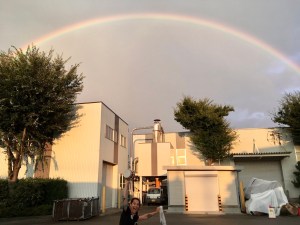
Rainbow over Asano factory.
September 3rd
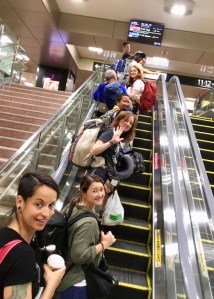
On our way to Sado Island.
Breakfast this morning was not as busy as the previous day; presumably the handball tournament had concluded. Once again I woke up early (my inner clock was all confused). So after a quick breakfast I went out for a short walk. A mistake. It was already very hot and humid. By the time I came back I was in need of a change of shirt.
Today was a day of travel. We made our way to the train station, where we purchased lunch boxes. If you have never taken the train in Japan, know this : they are on time (to the minute), are fast, efficient, and the stations are very clean, and fully serviced. A shinkansen (bullet train) took us to Joetsu. The train was fast and smooth. A bus then took us to the ferry, which brought us to Sado island. The ferry ride was not as smooth as the train ride but no one suffered debilitating sickness. A final bus ride took us to our rest for the night : Hananoki Inn. But before dropping our bags, we got to partake in a Japanese tradition : Onsen (a hot bath). They are supposed to have a relaxing effect on your body and mind. Yes, they do! It was bliss. Onsen come in many varieties : indoors, outdoors, gender separated, mixed, developed and undeveloped. Some belong to a ryokan, others are public bathhouses. There are thousands scattered across the country. Unsurprisingly, there is an etiquette to be followed. Yuta showed us the way. The hot bath was exquisitely hot. The cold bath was frigid however. Overall it was wonderful.


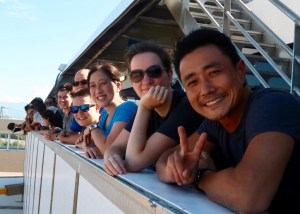


After a most relaxing onsen, we made our way to Hananoki. Housed in a 150 year old Japanese building on a beautiful piece of land, Hananoki stands in the borrowed scenery of mountains, with Buddha statues carved into the rock, and a huge Kofuku Jizo statue as backdrops. Because there were only four male participants (Daniel, Rhet, Richard, and myself), the men lived in relative luxury. While space was not exactly outlandish, we were very comfortable. The women, being more numerous, lived in tighter quarters. Richard installed his power command centre and we charged our phones. There was still time before dinner so some of us went to explore. There were beautiful views of rice field and a small shrine set in a bamboo forest nearby.
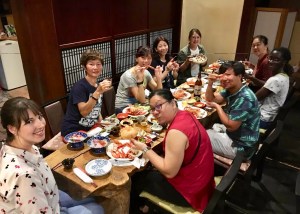
Dinner was outrageous; positively decadent. I could barely keep up with all the goodness. Two guests of honour joined us : Chika, who seemed as excited about KASA/MIX as we were; and Atsushi Sugano, Managing Director for the Kodo Cultural Foundation. Chika (in fact Silvana Imperatori, from Norway and not Italy despite what the name may suggest) is a recent graduate of Kodo’s Apprentice Centre. She was the hospitality manager for Earth Celebration 2018 and is now staff for Kodo’s Cultural Foundation. We would see her from time to time during KASA/MIX. She was always smiling and was obviously enjoying spending time with us. Because she had recently graduated from the Apprentice Centre, she could talk about what the Apprentices were experiencing. Atsushi, we would later find out, was an international calibre Frisbee athlete. He was a fountain of information (on Kodo, on Sado Island, on Japanese culture, on world culture). He was so chill. He would also re-join our group later. The evening ended with some sake (and/or beer and/or sodas) and a hilarious game (of which I will say no more).



September 4th
Some of us woke up early to go to the shore. Following breakfast (which included watermelon!) we made our way to Kodo’s Apprentice Centre. But first we stopped at Kodo Village. This is where Kodo’s Headquarters is located, along with residences, a recording studio, and a rehearsal hall. Six members of Kodo were rehearsing and we got an impromptu concert. They were phenomenal. Atsushi then gave us a tour of the main building, which houses Kodo staff. The main building includes an eating area and is decorated with artefacts from Kodo’s history. There’s also a library with books from all over the world. The Village is secluded and surrounded by nature.
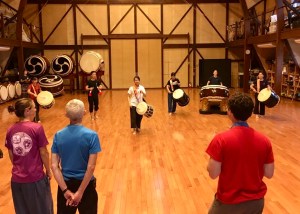
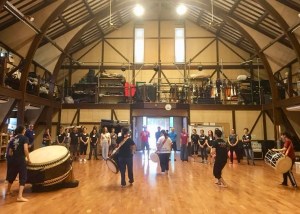


Close by is the Sado Island Taiko Centre, which we visited. Run by the Kodo Foundation, the Taiko Centre gives visitors a chance to experience playing taiko in a gorgeous site. It was built using Sado Island timber and has a balcony overlooking the sea, with mountain views and beautiful forests. A workshop was being run when we were there so we did not get to see the famous “natural taiko” (drums made from tree trunks left in their natural state). The two drums are massive and were hand carved from 600 year old trees by members of Kodo. The facility gives visitor a chance to access Kodo and Kodo members without invading Kodo Village. It also gives a boost to the local economy. Some of us tried to sneak a peak at the workshop but the windows were strategically blocked.

Arriving at the Apprentice Centre we were greeting by super enthusiastic, energetic, eager Apprentices and staff. The bus wasn’t parked that the Apprentices were playing music, waving banners, and shouting their pleasure at receiving us. It was wonderful. Yoko Fujimoto was dancing, using hubcaps as if they were fans, while Yoshikazu Fujimoto was playing a plastic trash bin as if it where an okedo. We were whisked inside the Apprentice Centre, where we were treated to a more formal performance. First, the Second Year Apprentices played for us. They were so good. It was inspiring. They formed a line and introduce themselves in English, giving their name, age, where they were from, some special talent or ability or feature they had, and their favourite topic of conversation. Some struggled a bit but I was impressed by their willingness to try and put themselves out there (not that they much of a choice but they did it with gusto). It’s not easy to stand in front of friends and strangers, and shout about yourself in a foreign language. Having just played your heart out for the past 15 minutes may or may not have helped. There were nine Second Year (seven males and 2 females). Tani made everybody laugh because he introduced himself as “Tani… Long Chin”. And he did have a long chin (he immediately made me think of former Prime Minister Brian Mulroney). Yuichi did a split (which drew a mix of admiring shouts and imagined pain). YonGun had a touching introduction. Originally from Korea, he explained that his goal was to get the people of Japan and Korea closer together through taiko. They were all admirable and inspiring.
After the introductions, the First Year took over and played music for us. Again, I was blown away by how good they looked and sounded. The First Years had started in April (four months earlier). They played Yatai bayashi (sitting face to the drum, leaning back; which is physically very demanding). They each took turns at the various positions (chu-daikos, shime, fue, atarigane). They were so impressive. There were eight First Years, four males, four females. It was hard to take everything in; the performance, the surroundings… talk about overstimulation. Following their performance, the First Years introduced themselves. Annina was from Switzerland and her English was excellent (she would become the de facto translator for her peers). Mika made everybody laugh because she pointed at her eyes, grinning, and introduced herself as “Mika… small eyes!”
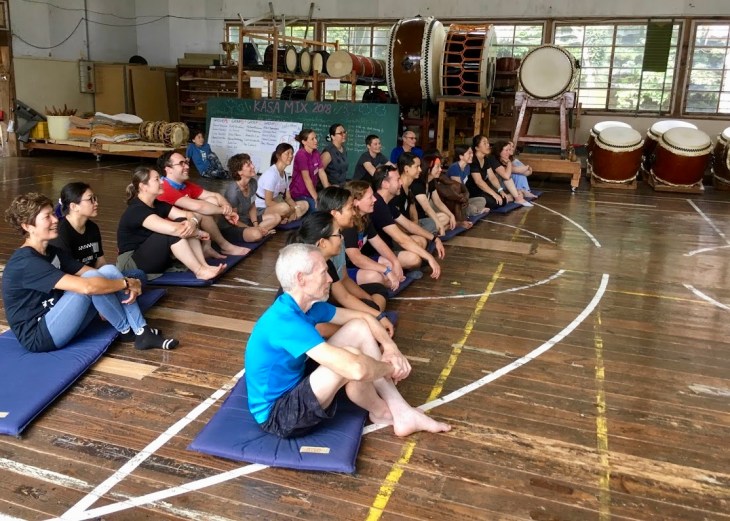
The Apprentices then shared their schedule with us. They had a big board and performed skits to demonstrate each activity of their very busy schedule. They lived a very regimented life. Up at 5am for exercise (they run every morning), cleaning, training; breakfast at 7 followed by more cleaning and getting ready for taiko practice. Practice starts at 09h30 and lasts until 11h30, at which point they get an hour of “free time”. Lunch is from 12h30 to 13h30, after which there is more “free time” (used for individual practice mainly). From 14h00 to 17h00 there is additional practice time, followed by 90 minutes of “free time” before dinner. According to the schedule, the evening is theirs (yes, more “free time”). Lights out is at 22h00. “Free time” is typically used for individual practice, chores, or actual personal admin. Theirs is not a life of luxury and idleness. Apprentices normally get a day off once a week however a week can be longer than the traditional 7 days. So a day off once in a while is more likely. Some of the KASA/MIX participants noted that it felt a bit like boot camp. Speaking as a veteran, I certainly felt in familiar territory. The Apprentices moved quickly and efficiently. They had the discipline of highly trained, highly motivated soldiers. Elite soldiers actually. Or maybe Olympic athletes.
After the introductions, we were treated to a song by the Apprentices led by Yoko Fujimoto and Yoshikazu Fujimoto. It was now time for Gan-san to share the next few days’ schedule with us, including cleaning duties. There were four groups : Corridor, Bathroom/Showers, Gym, and Dishes. Thankfully we rotated every day so nobody had to clean the toilets four days in a row. Gan-san is the manager of the Apprentice Centre. Before too long I suspected that his role was equal parts mother, father, sergeant-major, mentor, teacher, and then some more. After Gan-san shared the admin points, the Apprentices took us on a tour of the Centre. The Centre is housed in a small 1950s school that Kodo started using after it had been closed for lack of students. While beautiful (lots of wood) it certainly showed its age. Changes were made to accommodate its use by Kodo but as much as possible things are left “as is” (the idea being that Kodo is only temporarily using the school and will one day return it to the community). The walls still bear notices from school days.
We then had a quick lunch. On the floor. Japanese style. As an aside, I never got used to sitting so much. By Day Four my body was in open revolt and I just could not find a comfortable position. I would spend meal time (or anytime we had to sit for more than a few minutes), moving from one position to the other, in an ever fruitless pursuit of comfort. I was not alone in that.
All meals started with Itadakimasu (“I gratefully receive”) and finished with Gochisosama deshita (roughly “thank you for the meal, it was delicious”). One or two Apprentice would also be designated to introduce the menu (in English!).
The Apprentices cook their own food (in fact, they grow most of their own food!). The food was delicious. Truth be told, I expected the food to be rustic and a bit bland but the food turned out to be a highlight for me. I ate everything that was put in front of me and enjoyed everything. In fact, during the whole of my time in Japan there was only one dish I did not enjoy (I still don’t know what it was but I never finished it. For the record, it was not at the Apprentice Centre). At the Centre, I loved it all. My only regret was that meals were over quickly (I wanted to enjoy the food and the company but always seemed to run out of time). Seating arrangements mixed Apprentices and KASA/MIX participants. The Apprentices were instructed to sit with different participants each time. Some of us inadvertently made things more difficult for the Apprentices by changing spot every meal (sorry!!!).
Following lunch we had a voice circle with the beautiful Yoko Fujimoto. One of the original founding member of Kodo, she has dedicated her professional life to singing, launching multiple projects and spreading her love of singing. This is the workshop I was least looking forward. Singing is not something I do. Singing in public, even less. Yet, Yoko is such a lovely woman and effective teacher, I enjoyed it. I think everybody did. I suspect I was not the only one feeling a bit anxious about this workshop but Yoko had us singing and having a great time in lightning speed. She started the workshop by having us form a circle. She went around, introducing herself to each of us and chatting a bit. I was mightily impressed by her ability to make everyone feel at ease so quickly. She had that rare ability to connect with the individual and make them feel a genuine human connection. She also demonstrated another rare skill in trainers : the true understanding that “smooth is fast”; the counter-intuitive ability to start slower than natural yet reaching faster learning speed quicker than the usual “start at normal speed”. Soon, we were singing and dancing. I was pleasantly surprised to find out one of the songs Yoko taught us was a song I knew from Paula’s teaching : Usagi. There was a slight variation to how I had learned it but the lyrics were the same. Usagi is a children’s song about a rabbit leaping on a full moon’s night.


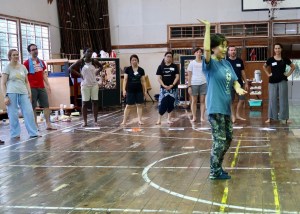
Following the singing workshop we played a taiko game. It was a variation of the classic children’s telephone game (also known as Chinese whispers, Arabic telephone, Russian scandal, etc). We were broken up in teams mixing Apprentices and KASA/MIX participants. My team did not win any round except the one that mattered most (because my team called out “next round wins!” just before we played that final round, which we won in extremis…). Does not matter, a win is a win. We celebrated like we had just won an Olympic gold.
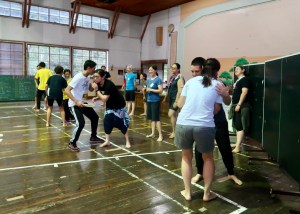


After the game, the participants were given free time to settle in and have a shower. As before, the men lived in relative luxury. Because there were 18 women, they had to follow a tight shower schedule. The four men simply showed up and showered. Our bedrooms were converted classroom. I say converted but all that meant was tatami mats had been placed on the floor and additional walls built (I think each room was half a classroom). I was delighted to find out my name had been written correctly on the door (a rare occurrence, even in my home province). We made our beds (futon), which were quite comfortable. The Apprentices had written a big “WELCOME!” on the chalkboard, along with drawings of taiko drummers and instruments. While comfortable and clean, it was a far cry from the modern hotel rooms we had enjoyed in Kanazawa. The Apprentices doubled up in separate bedrooms to make room for us. Still, we all felt giddy just being there. Rhet was positively over the moon.
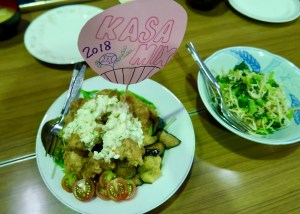
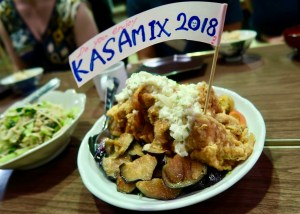
Dinner was at 18h30. What a feast. At every meal I was so impressed by the quantity and quality of the food. The Apprentices had even decorated the serving bowls with small welcoming signs. Throughout our stay, they would often add those little touches. After announcing the menu and saying thanks (Itadakimasu!!), some of the Apprentices entertained us with a short skit. This time, it seems two “bad guys” (complete with wigs, masks, and prop weapons) were intent to steal our food (or cause trouble at any rate). Thankfully, we were saved by none other than James Bond (who looked suspiciously like Take. Wait a minute, where’s Take? He’s missing James Bond!!). The skit got confused at one point (rehearsal was perhaps minimal) but eventually it all played out to a satisfactory ending. We cheered loudly at being saved and resumed eating. I noticed that the Apprentices were using their own self-made bamboo chopsticks. Only later did I notice they were holding their chopsticks in their left hand (or non-dominant hand). I had heard rumours about that. The theory is that doing so helps balance the left and right hands. Anybody will tell you that when you start playing taiko, your left (or non-dominant) hand initially feels “wonky”. I would eventually try holding chopsticks in my left hand but gave up quickly after a very modest progress because, well, I had to eat.

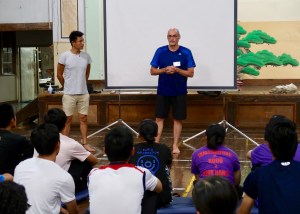
The evening was supposed to be spent observing an ondeko (demon dance) practice. Unfortunately, a typhoon was sweeping the area and practice was cancelled. Yui and Yuta reacted smoothly and instead we listened to a few pre-identified KASA/MIX participants talk about their taiko group and experiences. But first, Atsushi gave us a lecture on ondeko. It helped us understand the meaning and importance of those dances. Later in the trip we had an ondeko workshop planned. I was excited and looking forward to that day.
Lucy was the first KASA/MIX participant to present. She talked about her group (Kagemusha Daiko) and taiko in the United Kingdom. Lucy had played a major role in the third European Taiko Conference, held earlier in the year. It seems the European taiko community is not as established as the North American taiko community but in recent years has progressed in leaps and bounds and looks much stronger now, thanks in no small part to Lucy and others like her who are so passionate about taiko.
After Lucy we had a presentation by the five Singapore ladies (Annie, Irene, Jo, Jenn, Jane). They talked about their group (Hibikaya Singapore) and taiko in Singapore. Because of its close proximity to Japan, Singapore is able to attract plenty of reputable instructors. As a result, taiko is thriving in Singapore. The Singapore ladies were the largest contingent of any on KASA/MIX 2018 and quickly developed a reputation for having a lot of fun and loving to shop (Shopping! became a semi-official battle cry for our Singapore contingent; they were a crack commando when it came to shopping and could find you a deal where none was suspected).

Ilka came next. Ilka leads a group in Heidelberg, Germany (Taiko Heidelberg) and talked about the challenge of teaching taiko to older students who may or may not have musical background (I could definitely relate). She shared tips and made everybody participate in a learning exercise that turned into a lot of fun (the Apprentices seemed to enjoy it even more than any of us).
Daniel followed Ilka. Hailing from Montreal, he talked about his group : Arashi Daiko. It was interesting to learn that most groups share the same challenges and have similar activities. In the case of Arashi Daiko, the thing that struck me most is that any new performing member must be voted in by all the current members; the decision must be unanimous. That is unusual for a taiko group. In many ways Arashi Daiko strives to imitate Kodo. They have sent participants (at least one but up to four at a time!) to each and every KASA/MIX edition since the very first one. That’s a record!
Rhet and Ami followed Daniel’s presentation by talking about taiko in Australia. Their groups (Taiko On and Wadaiko Rindo respectively) were located in different parts of Australia and were representative of the taiko community there. Rhet’s group was still facing what is probably the biggest and most common challenge of any taiko group: finding a practice hall. At one point, they were using a parkade in an industrial part of town (from which they got booted out from by an unhappy tenant!).
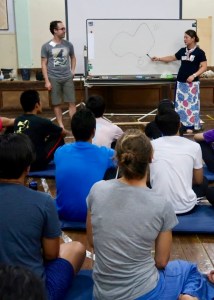
Last but not least was Diana, from Naruwan Taiko. Diana (whose favourite colour is green, let there be no doubt) had founded Naruwan Taiko ten years ago. Sharing genetics with the energizer bunny, Diana was also one of the funniest individual on the trip.
By that time the typhoon was making its presence felt. We retired for the night and the men discovered that their room was leaking. Buckets were found and strategically placed and we went to bed to the sound of fierce winds and rain.
September 5th
Day two began like every day at the Apprentice Centre begins : physical exercise! We were woken up at 6:30 by the sound of hyoshigi (two pieces of hardwood clapped together). The Apprentices were already up and invited us to form a circle on the pitch in front of the Centre. Annina led the stretches and invited us to count along (ichi, ni, san…). We were offered a drink (water or tea) and separated in three groups : fast runners, “normal” runners, and slow runners. Somehow Diana felt I was a fast runner and dragged me along with Ilka. Did I mention I hate running? Ryo was the Apprentice leading the group of fast runners. He took off like a hare and we played catch-up. The run was all uphill, at a steep incline. Thankfully, if I am to run I much prefer going up-hill. Soon enough, it was just me and Ryo; who shared that he hated running but felt that the faster he ran, the faster he’d be done with the running (can’t fault that logic). About 200m from the end, he looked at me, and asked if I was doing all right. By that point I was making noise like an asthmatic but gamely gave a thumbs up, which he returned. Apparently that was the signal for the final sprint. If Ryo was running fast before, now he was doing his best imitation of Usain Bolt. Forcing my body to sprint (it was an admirable 2% increase on my previous speed), I also “sprinted” to the finish line. Just before my lungs exploded I gratefully reached the end and high-fived Ryo (who looked like he was just recovering from a nice, slow, refreshing stroll).
I didn’t get much of a break before others started to arrive so of course I sucked it up and pretended I was fine (I vouched then that next morning I would join the “normal” runners. Of course I didn’t). Thankfully, the return home was a walk, all downhill. I learned that normally the Apprentices run about 6km along the sea (mostly flat) before running uphill for another 1.2km. I teased Diana mercilessly, asking if she had enjoyed looking at my back on this first run. She vowed that tomorrow would be different (it wasn’t).


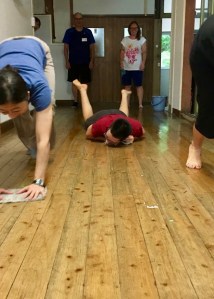
Breakfast was as tasty as the previous meals. The eggs were amazing (I later learned the Apprentices had scrambled some 40 eggs for breakfast!). Alas, it was over too quick. We then had to do our chores. My squad was lucky enough to get “gym cleaning”, which meant washing the floor Japanese style (pushing a rag in a crouched position). For reasons I can not begin to explain, this seemed the most popular of the chores amongst participants (although it’s fair to say that “bathrooms/showers” was never going to be on anybody’s list of favourite chore). Being new at it the KASA/MIX participants turned cleaning into a game, racing the length of the gym floor (and often stumbling and/or collapsing in a most inelegant fashion). While we enjoyed doing the chores and laughed a lot, I realized that doing this every day for 2 years might not be as much fun. The Apprentices would later comment that doing chores with the participants made the chores seem more enjoyable.


The first workshop of the day was “Bachi Making” with Tomohiro Mitome. A bachi is a drumstick. With a ready smile and superb skills, Tomohiro is the main instructor for the Apprentices. I was looking forward to this workshop because it was different from drumming and I was very intrigued. I was also a little bit anxious because I’m not exactly Mr. Handyman. It did however sound inescapably cool to make your own bachi. Blacksmiths make their own tools when they begin their apprenticeship. It made sense for Kodo Apprentices to also make their own bachi, given that bachi are their “tools”. When you make your bachi, you are crafting your sound; the bachi is your tool, your instrument. Tomohiro (with Yuta translating) explained that Kodo members make their own bachi and treat them with care. He continued that we were going to learn how to make our own bachi and, because they were our first pair, not to expect perfection. Tomohiro added that because we make our own bachi we should treat them with care and respect. I later learned that when a bachi breaks, Kodo drummers collect the pieces and once a year ceremoniously dispose of the pieces (I believe they burn them). It all sounded very cool to me and I was eager to begin. But first, a safety briefing and fitting of a protective glove (losing a finger would be bad, yes). Unlike Western hand planes, Japanese planes are pulled (and not pushed). In theory, making bachi was simple. You start with a rectangle piece of wood (well, two actually). Then you shave the corners (making 8 corners), which you then shave again (16), and once more (32). By then, your piece of wood is close to having achieved circular shape. Then it’s just a matter of angling the ends and sanding the whole. Voilà! Easy peasy.


Except that in practice it’s not that easy. To begin with, you have to be careful and be smooth and regular, all along your shave, and around. Also, you have to make sure not to over-shave (easier said than done). It is quite easy to start with a perfectly workable piece of wood and end up with unusable bachi. In the end, I was rather pleased with my efforts and received a few compliments from attending Apprentices. I was less pleased the next day when it was time to actually use them : mine felt so heavy. Also, later that night I weighed my handmade bachi and discovered that I had started with a gram difference between my two initial pieces of wood but ended with 23g difference when all was said and done. 23g!?! Anything more than a 10g difference is noticeable. For that reason, I did not get my bachi signed; I figured I would sand the heavier bachi and make my pair of similar weight.
Time flew and a few of us (especially the perfectionists) were not done sanding before it was time for lunch. We were promised time in the evening to finish. In the meantime, we enjoyed a fantastic lunch. Again, I was impressed by how good the food tasted. I guess using quality ingredients to begin with makes a huge difference. In the early days, the Apprentices cooked their own food (presumably with varying degrees of success). A few years ago however, a cook was assigned to supervise (and supplement cooking skills when needed), and make sure meals were balanced, varied, and nutritious. I’m sure it helped considerably. During our visit Mari Takatsu was the cook on duty (did I mention the food was awesome!); I still think they should publish a cookbook. Sometimes she’d be helped by Eri Uchida, a Kodo member who is one of the “adults” helping to take care of the Apprentices (Gan-san can not be everywhere all the time!). Eri was very discreet but she’s no pee-wee : she founded her own taiko group while in high school, composed a number of pieces (including Harewataru, one of Kodo’s most beautiful song), and was a driving force behind a number of recent initiatives (like Roots of Kodo). Still, the Apprentices do the all the planning and cooking. A few times during my stay at the Centre I saw a pair of Apprentices with pen and paper go over supplies and carefully make notes. Kodo Apprentices might be there to learn how to drum and one day join Kodo but in the meantime they were learning many and varied life skills. As for KASA/MIX, I learned that one Apprentice was designated to lead and organize our stay at the Apprentices Centre. In fact, Apprentices are regularly given such projects to lead. It must have been stressful for a 19 year old to be put in charge of making our stay go smoothly (but Riki did a fantastic job!).
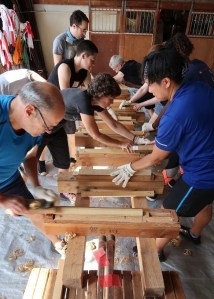

That day my group had to help clean the dishes. It was amazing how many dishes there were. Normally, Apprentices eat in the library/meeting room. But with KASA/MIX visiting, there were far too many people to accommodate; the “dining room” was set up in the gym instead (and taken down after each meal to be stored in one corner). The dishes were washed and dried in the kitchen and it was tight. The Apprentices however cut us loose early. Unbeknownst to us, the Apprentices were also taking turns in the laundry room to make gifts for us (more on that later).
The afternoon workshop was also with Tomohiro : “Basics”. It was a review of fundamentals of taiko drumming. I was keen on that. I won’t get into details (lest I bore the non-taiko players out there) but a few things bear mention. First, Tomohiro informed us that he would teach us Kodo’s way of drumming. In the same breath, he added that Kodo was not the be all end all of taiko drumming and that there are plenty of groups out there. It was up to each group to decide on and develop its own style. Furthermore, Kodo was still exploring and learning, and he encouraged us to do the same. Second, when learning fundamentals, Kodo instructors liked to use okedo (specifically okedo with horse skins) because it was less forgiving (ie: mistakes could be more quickly identified and thus corrected). Third, Kodo looked at everyday life to inspire its techniques (and there he gave the example of twisting a wet rag to dry it out). The idea was to find the best, most efficient way to perform a movement and apply it to drumming. In the same vein, Tomohiro explained that Kodo firmly believes that lifestyle impacts performance; hence the way the Apprentices lived and the lifestyle promoted by Kodo. Before we even hit the drums, Tomohiro made us do exercises, first using towels, then fans. This was to get a feel for proper technique.

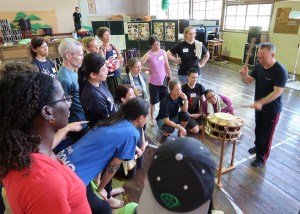
At one point Rhet asked a question and Tomohiro used it as an opportunity to teach us the importance of critique and helping others in their technique. Poor Rhet had to stand in front of everybody and perform an exercise alone while we all watched and critiqued his technique. We then split into small groups and repeated the “critique” exercise. It was a bit uncomfortable at first (for both the critiquer and the critiquee) but we had multiple opportunities to increase our level of comfort. We did a number of drills, with Tomohiro keeping the beat in the middle of our circle (Shoma and Sunao also played the shime to help keep the beat). It all went by so quickly. We ended the workshop by splitting into two groups and playing “against” each other (and then all together). This involved a lot of shouts (kiai!) and silly lyrics. It was a lot of fun. By the end my hands were so sweaty I was at risk of losing my bachi (the image of my bachi flying across the room and hitting somebody started to make its way into my brains). Thankfully it never happened. After the drumming, there was a short Q&A session; it could have lasted two days and I do not think we would have exhausted all we wanted to ask Tomohiro. As if that wasn’t enough Tomohiro then played a little bit of Odaiko for us. He then surprised us by giving each of us a bag for the odaiko bachi we had made. He himself had made the bags and was generous enough to sign them for us. I was ecstatic. What a gem of a man.


Before dinner, Gan-san opened up his shop (Kodo souvenirs). KASA/MIX participants descended upon it like it was Boxing Day. I pretty much spent all my money there (to the point that I had to borrow money for the rest of our time on Sado island. Thank you Yuta!!)
Dinner was as tasty as every previous meal. Our evening entertainment became a crowd favourite : a trio of Apprentices (where did Keita go? Where’s Takeru? Wait, is that Ryo?) donned wigs, tights, stretchy tops, and make-up, and performed a dance routine to the sound of Taylor Swift. They were quickly dubbed the Lipstick Boys and we would see them again (to everybody’s delight).
During dinner I happened to be sitting next to Moe and asked her what was her cooking specialty. She hesitated, thought for a moment and then proudly announced that she made the best spring rolls. I looked at the Apprentice sitting across (I think it was Kei) and asked if it was true, did Moe make the best spring rolls? Moe quickly jumped in and said something sharp to Kei in Japanese. Kei then sheepishly answered me that, yes, Moe did make the best spring rolls. Uh-hmmm…
After dinner we did an English practice circle with the Apprentices. Participants were paired up and the Apprentices came around to practice their English. We asked them questions like : “What is your favourite animal?”; “ Where have you travelled and where would you like to travel to?”; “If you could be a drum, which one would it be and why?”, etc. My partner was Lee and she was so good at it I felt compelled to compliment her about it. She explained that she had been teaching English in Korea for a while so this was nothing new for her. She was so good; she made the Apprentices comfortable even when they clearly were struggling and unsure of what to say. Sometimes you could see them racking their brains, trying to come up with an answer. I though their English was 100 times better than my non-existent Japanese and I admired their courage.
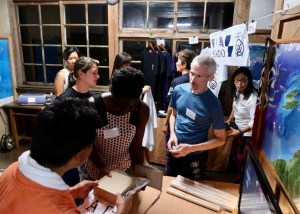
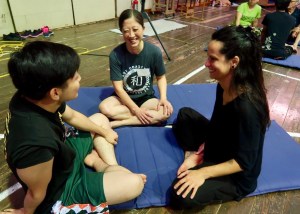
We later got our chance to see the Apprentices (and locals) practice ondeko (demon dance). “Demon” (Oni) in this case did not carry the same meaning as in the West. A demon is a supernatural being who protects a village and its inhabitants. There are over 100 demon-dancing groups on Sado Island. There are many variations in the dancing styles but all have in common masked “demons” dancing to drums. The demons dance to drive away evil spirits and to ensure a good harvest.
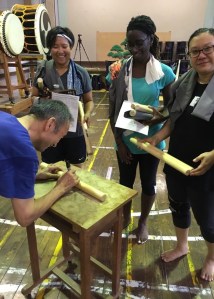
To facilitate transport, and not overwhelm the practice stage, we were split into two groups. I was in the second group so had an opportunity to improve my handmade bachi. Yuta also took the opportunity to teach us a neat drill. It was an unexpected bonus (and fun to boot). It was a short drive to the shrine where the practice was being held. We were instructed to be very quiet and as discrete as possible (definitely no photos). There were in fact multiple groups practicing. It was humbling to be allowed to witness the ondeko. The Apprentices looked amazing (and the dancing looked very difficult). We only stayed a few minutes before returning to the Centre.
September 6th
Day Three at the Apprentices Centre began like every day at the Apprentice Centre begins : physical exercise! We were woken up at 6:30 by the sound of hyoshigi and made our way to the pitch to do some stretches before going for a run. The run did not feel as bad as the first day. I still somehow ended up finishing first amongst the KASA/MIX participants (to be clear : ahead of Diana. Again). Everybody ran and finished strong. It was a beautiful day.
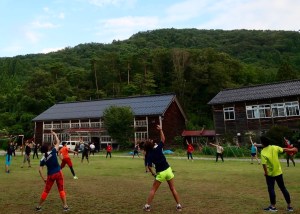

There was a special treat for breakfast : bread. Apprentices are not allowed bread as part of their regular diet. During the menu presentation, it was specified that there were two bread rolls per person. Most of us ate one and offered our second roll to a grateful Apprentice. Annina, a first year Apprentice, confessed that bread is what she missed most. Her being a native of Switzerland, that made perfect sense.

That morning my squad was on bathroom/shower duties. There really was nothing to it, given the number of us cleaning. Frankly it was pretty easy. I shared cleaning duties with Shoma, who in his introduction on the first day had shouted “I love monkeys!!”. When asked why he loved monkeys so much, he explained that as a child he had visited a monkey sanctuary and held a baby, who fell asleep in his arms. Shoma was a second year Apprentice and had a quasi-permanent smile during our stay.
The first workshop of the day was Katsugi, with Yoshie Abe. Yoshie held the distinction of having left Kodo to raise a family, and then coming back. She was a wonderful instructor. We started with a bow from the seated position (executing a more formal bow), before learning how to rope our okedo drums (which became a bit confusing because it seems every member has a preference and there are slight variations in how the drum is roped). I decided to follow Yoshie’s method.


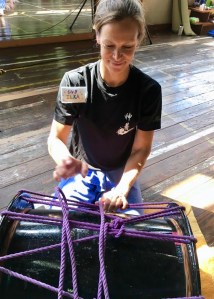
Yoshie then taught us how to stand and walk with our drum, making it an extension of the body. She made it look so easy. Of course, it wasn’t. We learned a few patterns and then practiced some more. Along the way she provided individual feedback, corrected mistakes, and offered encouragement. I thought she was a very effective instructor. Soon she had us all in a circle and drumming faster and moving to the rhythm. Katsugi quickly turned into my favourite workshop. So much so in fact that before the end I decided that upon my return home I would purchase an okedo and learn to play katsugi in depth (Mr. Kato, I have an order for you!). The workshop ended with some deep stretches (some of which I was not familiar with but found very effective). Actually, the workshop ended like it began, with a formal seated bow.
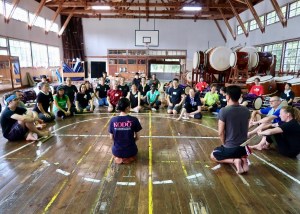

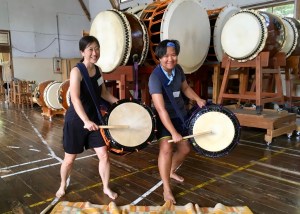


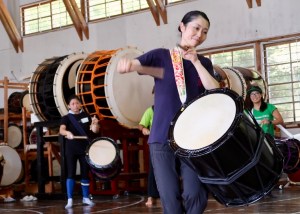
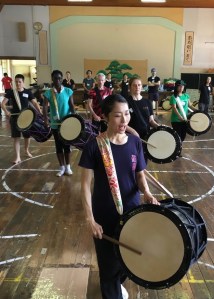

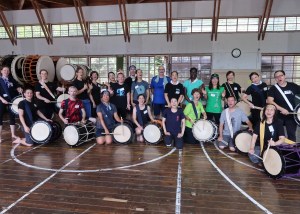
Lunch was also special : spaghetti! Chiara, the sole Italian KASA/MIX participant, was beyond happy (and so were most participants). It was a nice change from rice. The Apprentices also seemed to really enjoy the pasta. It was the only time I saw them use a fork instead of chopsticks (and yes, they held the fork in their left hand). The meal was amazingly tasty (and I did not shy from telling the Apprentices). I was so impressed by the quality of the food. That day I was wearing a t-shirt with a drawing of a racoon. Mika explained that they did not like racoons because they came at night and raided their vegetables patch. I immediately folded my t-shirt and used a safety pin so the racoon was invisible. Voilà!

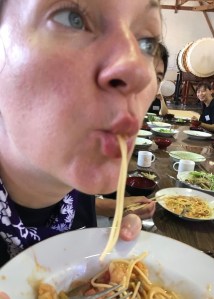
Yui and Yuta had given us instruction to offer drinks and serve the Apprentices as much as we could, and not let the Apprentices do all the hospitality work. This was easier said than done. Most times I would offer to fetch a drink for the Apprentices at my table only to be politely denied. Maybe they were surprised by our offers. They took their hosting duties seriously. By the end of our stay however, they seemed more comfortable accepting some basic hospitality. On the first night the Apprentices had offered to do laundry for us. That made me a bit uncomfortable and I finally, grudgingly put two sweaty t-shirts in the basket. It’s not that I didn’t like the idea of somebody else doing my laundry for me (who wouldn’t want that?!?); it just felt like the Apprentices were already doing so much for us. But I was grateful for the offer (and two clean t-shirts!). I had not packed enough warm weather clothes and with all the heat and humidity, I was going through my clothes like candy.
For dessert, there was some kind of pumpkin cake. It was also incredibly tasty. There were three pieces left over and the Apprentices decided to run a competition to decide who would get them. Somehow I was entered in the contest. We did a rock-paper-scissors tournament. My ridiculous competitive side took over and I survived the first two rounds but got eliminated in the end. I think I had as much fun playing as I would have had I won the cake. Later on I saw Yuta play a Japanese variant to rock-paper-scissors (no, no dynamite or any other silly option you sometime see). The Japanese variant is that you do the normal rock-paper-scissors; whoever wins that phase then points at the nose of the other player and quickly moves the index left, right, up, or down 3 times; coming back to the nose in between each move. The other player must move their eyes in the opposite direction (right, left, down, up) or face “punishment” (usually a slap on the wrist). Try it; it’s harder than you think.
The afternoon workshop was Odaiko, with Yoshikazu Fujimoto. If you have ever seen Odaiko played by Kodo in concert, there is a good chance you saw Yoshikazu. A legend, he is one of the founding members of Kodo. He is currently Kodo’s most senior performing member. I was floored when I learned he was approaching 70. He certainly didn’t look it (I guess playing drums helps keep you young). Despite his age and stature, he was an irrepressible kid. You could tell he loved taiko, loved teaching, and was keen on sharing his passion with us. Most of us used the bachi we had made with Tomohiro the day earlier. That’s when I discovered how heavy mine really were. I felt like I was going to lose them any moment (Yoshikazu even noticed and told me “Kelly-san, relax grip!”) He was right of course but by the end of the workshop I had decided I would definitely play odaiko with lighter bachi.
The odaiko workshop was probably the one I most looked forward to. It turned into the most challenging. My first challenge was that Yoshikazu tended to teach by doing air-bachi facing us. Which is a sensible way to do it because it allows the teacher to see the students. Except it is not the way I’m used to. It confused the heck out of me. My little brains kept getting cross-wired. Thankfully he sometimes turned his back to us and that made it easier for me to follow. The bigger issue however was that the pace was a bit fast for me (I’m still a novice! A slow-learning one at that). Understandably the piece he wanted to teach us was fairly long, so we could not afford to go too slow. Also, I was by far the most novice participant; and you can’t nor should you go at the speed of the slowest learner (when it comes to taiko, I really am a painfully slow learner).


It wasn’t long before I fell off the wagon and playing catch-up. Except that I have learned through painful experience that I when it comes to taiko, I can’t play catch-up. I just keep getting further and further behind until I reach a point where it seems all is lost. Goodbye train! Thankfully it was time for a break. Yuta spent the break rehearsing the phrases we had learned with me. I regained some confidence.
After the break, Yoshikazu gave us a music sheet. Taiko does not have notation. A few systems exist but there is no consistency across the taiko community. He had made the effort to translate the phrases into Western style notation. Except that I can’t read music (Western or otherwise). But that wasn’t the biggest issue with the sheet. My jaw dropped when I saw the length of the piece Yoshikazu wanted to teach us. We had only learned an eight of the phrases. To be fair, he had said at the beginning that it would be a difficult piece. Also, phrases were repeated throughout the piece. Still, I felt pretty deflated.
Yuta graciously stood by my side and helped me along. I felt terrible though as I was monopolizing his attention (I’m sure other participants would have appreciated some help). Thankfully at one point he moved on and tried to help others (I wasn’t the only one off the wagon by that point). Apprentices took over from Yuta and helped me along (thank you Sunao, YonGun, Shoma and Yuichi!!!!). By that time though I was a lost cause. I could play the first few phrases but only stumbled through the rest of the song (my playing bore no resemblance to what was supposed to be played; it was like doing a solo in the midst of a melody, out of sync and off beat). I felt bad for the Apprentices; they had to endure my making a mess of their craft. Still, they never gave up nor gave any indication that they were exasperated.
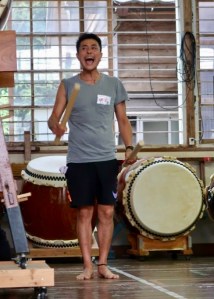

Part of the KASA/MIX experience for the Apprentices, I believe, is to see masters teach taiko. They act as helpers and observe the teaching techniques being employed. All the workshops are recorded (which, when I noticed the camera being set up and the Apprentices hanging around on the very day gave me pause for thought). The camera was not intrusive though and you quickly forget it’s even there. And the Apprentices are so eager to help and patient, and good-natured, you can only appreciate their presence.
The workshop did end on a very positive note though : Yoshikazu demonstrated and explained his stance when playing odaiko. It was fascinating to learn the symbolism behind his movements. He played for a few minutes and put so much into it that by the time he was done his shirt was drenched with sweat. That was a constant with Kodo (Apprentices or members). When they played, they played with their whole heart and body; invariably they were covered in sweat by the time they were done. Yoshie was the only one who didn’t seem to sweat (that’s only because she was too graceful to sweat and angels don’t sweat anyway).

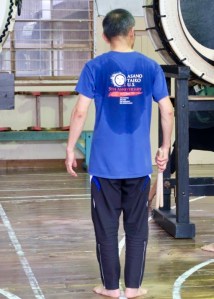
Followed a short Q&A period during which, among other things, Yoshikazu talked about stage presence. He stayed behind to sign autographs for participants (truth be told, Yoshikazu is nothing short of a legend so it was natural for us to line up). Some had their bachi signed and I considered it. But because mine weren’t done yet it would have been silly to do so. Instead, I asked him to sign one of the posters he had brought and given to us. It was funny because there was very little empty space on the poster; I could tell he was trying not to cover up the writing or any image, and struggling with it. I felt like telling him not to worry; I can’t read Japanese anyway!
September 7th
Day Four at the Apprentices Centre started … well, you know the drill. The prior evening I had promised Diana I would run circles around her. And I did just that. As soon as I was finished running to the finish line, I turned around, ran back to Diana and started running circles around her. She landed a few slaps as she continued to run while shouting at me. It was wonderful.
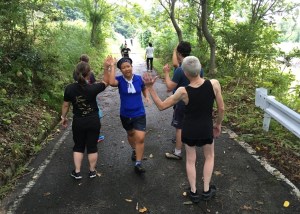
On the way back to the Centre, the Apprentices took us on a slight detour to visit their rice field. They harvested around 300kg of rice from their field. They were visibly (and rightly so) proud of their work growing their own food (there was also a vegetable garden behind the Center). I was impressed and happy for them (and us, since a lot of the food we ate during KASA/MIX came from the Apprentices’ fields). I thought back to my own tiny, dismal vegetable patch at home and realized I could “up my game” a little.

Breakfast included the option of a raw egg mixed in with rice, which I tried. It was delicious. I do not know what it is about eggs in Japan but they are amazing. There was also the option of adding natto, which some of us had tried before. Natto is a traditional Japanese food made from soybeans fermented. Natto is definitely an acquired taste. I didn’t mind it so much but it certainly didn’t look appetizing; it has a powerful smell, strong flavour, and sticky, slimy texture (think spider web). Mixed in with the rice, some mustard, and the raw egg, it was not bad at all (but difficult to eat with chopsticks). Not many people tried the raw egg. Fewer still tried the raw egg with the natto.
Once the chores were done, the morning was devoted to shopping (shopping!), packing bags (we were leaving later that day), and preparations for the end of visit BBQ. We were given our KASA/MIX t-shirt (sporting a design by Yoshikazu) which we proudly donned for the festivities.
During the morning we also participated in a sharing circle. The aim was for us (Apprentices and KASA/MIX participants) to share what we had felt and experienced during the last 4 days. It became emotional at times and some of us struggled to maintain our composure. At first, we were all too shy to speak. But Jumpei, whom I thought so quiet the whole time, stood up and shared his appreciation. The dam was opened. Round we went, each one standing up and sharing. Yui made sure both Apprentices and Participants had equal chances to speak (time constraints meant not everyone got to speak). Yuta translated into English or Japanese, whether the case may be. Lovely Ilka was so moved that twice she had to sit down and try again later. I was struck by how hard on themselves the Apprentices could be. One of them (I think it was Sorami) apologized for the food not always being ready “on time” or always cooked properly. What are you talking about??? A few expressed frustration at not being able to communicate better with us in English. That sounded crazy to me; what about us? I certainly didn’t speak Japanese; why would I expect them to speak English? Thankfully, it wasn’t all Stalinist self-incrimination, far from it. Most participants were grateful for a wonderful experience and shared their happiness at having experienced KASA/MIX, and sadness it was coming to an end. As a Participant, I had been so impressed by the Apprentices, their energy, enthusiasm, taiko skills. I, like many (if not all) of my fellow KASA/MIX participants, found them inspiring. And I told them so. I spoke about their courage, dedication, discipline, will to succeed, and great sense of humour. Megumi was grateful, among other things, that we had learned her name and used it when addressing her. A few of them stated that meeting us had inspired them to try even harder at becoming the best taiko drummers they could be. There was laughter too, and it ended with hugs.
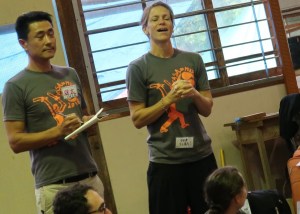

Afterwards the Apprentices surprised us with gifts. Unbeknownst to us, they had taken turns hand sewing personalised bachi bags. As if that wasn’t enough, each bag came with a rice panicle (flower cluster) from their field and a handwritten note (in English!). It was an incredibly touching gift. If I had “kept it together” during the sharing circle, this nearly pushed me over the edge (I think shock saved me). For a split second I entertained the idea of kidnapping an Apprentice or two and bringing them back home with me.


The BBQ was amazingly tasty. It was a chance to talk with the Apprentices, hunt for signatures, exchange hugs, and share final thoughts. I was mighty pleased that I managed to get every Apprentice’s signature on a Kodo towel (it now hangs proudly in my office). Sadly, it came at the cost of not eating as much as I would have liked. Did I mention the food was amazingly tasty? The Lipstick Boys surprised us with an appearance (having enrolled two additional troop members). They received wild applauses. Participants, led by Ilka and Chiara, finally performed their own skit to thank the Apprentices (a rendition of We Will Thank You). Not to be outdone, the Apprentices multiplied everyone’s joy by performing for all. They first did a demon dance (Moe and Suano were so good!) before moving to a miyake style show. They even invited some of us to come up and play with them. No one dared moving. What? Me? But eventually Daniel broke the ice and others followed. It was my first time playing miyake style (and got a surprise when I first hit the drum; the bounce back surprise me so much that I dropped my bachi). But I was game and played while Kei and others kept the beat (I also made a less than optimal choice, playing with my back to the audience. But nobody took exception). It was pure joy, everybody playing with abandon. Tomohiro joined in the fun and put in quite the performance (so much energy!). The Apprentices then performed their samurai sword and fan dance. Even Gan-san joined in. The final performance was a piece by Tomohiro and Yoshie. While he played the shamisen, she played what looked like a hand-held koto (I’m sure I saw angels floating behind her head as she was playing and singing).



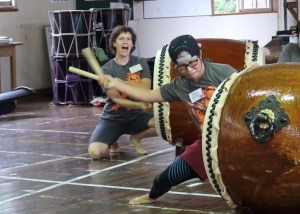
There was a final group photo and then we had to leave. Nobody wanted to leave. It was a sweet-sour moment. The Apprentices continued to play as we piled in on the bus. It was raining by that point. They chased us as the bus was leaving, reaching out to shake our hands through the open windows. They played, and waved, and sang until we couldn’t possibly see them anymore. Followed a moment of charged silence in the bus, as everyone was lost in their thoughts; trying to processed what they had just lived. It was an emotionally intense moment. The time spent at the Apprentice Centre is at the heart of KASA/MIX and the stage for the most powerful memories for the participants. It is where you forge the deepest connection to the taiko community.

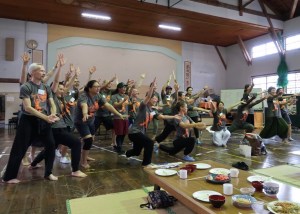

We had an hour drive to our new home : Fukaura School House, where we were to participate in an ondeko workshop. The school was a project of Kodo’s Cultural Foundation. Built in 1912, it had been closed due to rural flight and was in bad need of repairs. Kodo funded renovations and the school was transformed into a retreat and learning center. At the school Kodo organizes regular workshops and activities for the community. The facilities are gorgeous. There is a huge gymnasium with a theatre stage, classrooms, sleeping quarters, a full kitchen, and a large field for outdoor activities. Three Kodo staffers were waiting for us at the school : Hirofumi Uenoyama, who left early to attend other duties, Chika, whom we had met earlier, and Okome-chan, a former Apprentice who would be in charge of the kitchen.
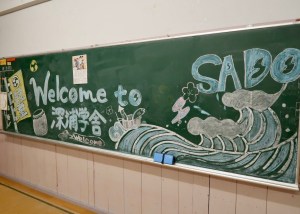
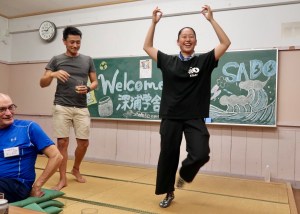
I was pretty excited by the upcoming workshop. Sado Island is famous for its Ondeko Festival. Demons (Oni) are not necessarily evil, but embody and personify human failings, natural disasters, diseases, impurities, and disharmony. They are powerful, supernatural spirits, able to travel between the realms of the Gods and the people. As they dance from house to house, and shop to shop, they draw out and drive away bad fortune, while inviting prosperity, good health, and harmony for the members of the community.
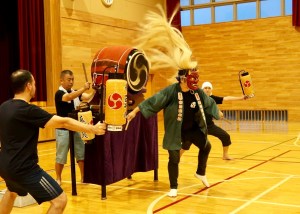
There are many styles of ondeko and we were set to learn Kasuga style ondeko. Kasuga Onigumi instructors, led by Saito Hirofumi, taught us parts of the male and female dances. I loved it. Despite the heat and high humidity (we were soon dripping with sweat) it was a lot of fun and we made quick progress. The workshop began with a demonstration by Saito’s son (who skipped school so he could join us). He was amazing. Wearing full regalia, complete with a mask sporting long horse hair that he would flick with small bachi, he danced to the drum, demonstrating great skills. Later we had a second demonstration by another member of Kasuga Onigumi (who happened to be a journalist). The costume was impressive but the mask especially. At the end of the workshop they even let us try the masks on. They were quite heavy! The pièce de résistance though was Saito himself, who performed the final act. He was simply amazing. Much like the Kodo performers, he put so much into the dance that by the end he was near-collapse. It was an astonishing display of energy and skills. I was sorry it had to end. It was a tough choice between this workshop and the katsugi workshop as to which was my favourite.
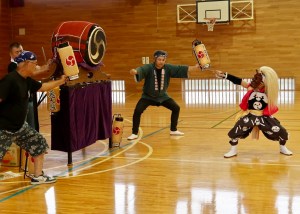


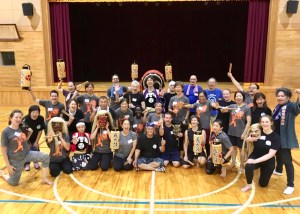

Members of Kasuga Onigumi joined us for dinner (the food was wonderfully tasty, thank you very much). I was lucky enough to be seated next to Saito, who spoke excellent English, having studied in the United States. I was very curious about Sado and ondeko and he was only too happy to answer my many questions. Turns out he was also Section Chief of the Sado Tourism Promotion Division. Unfortunately our guests had to leave early, as they lived on the other side of the island. We waved them goodbye and resumed dinner. Everybody helped out with the cleaning.
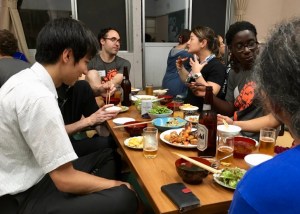

The evening was spent chatting and sharing. Yui produced some sake bottles and we polished them off. Rhet taught us his signature dance move (he had two in fact but one was the bigger crowd pleaser). Okome-chan tried her hand (and feet) at highland dancing. There were a lot of toasts. The night was short. When I finally retired to bed, a group was still going strong.


September 8th
The next morning started with a bang. That is, Daniel hit his head getting up from his bunk bed. Followed a long list of expletives in québécois, which made both of us laugh. Daniel was the tallest of our group and he routinely bumped his head on the many low ceilings. He wasn’t done yet.
The day was to be spent on Sado Island, learning about its culture and history. Atsushi was our guide. He was like a living, breathing encyclopaedia. Our first stop was a short tub boat tour in Ogi. The sea was fairly rough and the tub boat swayed quite a bit. I was astounded to learn that Sado Island residents had used them in the past to get to the main island (it must have been a very long trip). Like the name suggests, tub boats are shaped like a big wooden tub, like the bottom of a giant wine barrel. They are propelled by a single oar, which our guide used expertly. Tub boats disappeared from Sado Island until an American (Douglas Brooks), who had learned from the last Japanese master builder and published a book about their construction was invited (with help from Kodo’s Cultural Foundation) to teach locals how to make them. The ride lasted only 10-15 minutes but the bay was beautiful, lined with vegetation and rocks.


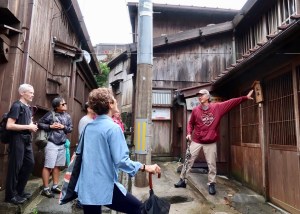
After the tub boat ride we had a tour of Ogi, which incorporated traditional architecture. A street corner was the site of a famous tourism campaign so we took turns getting photographed (I looked nothing like the model in the original photo, a very famous Japanese actress whose name I have forgotten). Ogi includes a hall where, once a year, second year Apprentices perform with members of Kodo for the local community. The concert is performed to a capacity crowd and is a special moment for Apprentices (and much anticipated by the community, every year). There is also a temple, whose gate doors were built by local carpenters. One door was built by the house carpenters and the other door by the boat-building carpenters. The boat-builders’ door is easy to recognize : theirs has the perfectly, tightly joined wood planks.


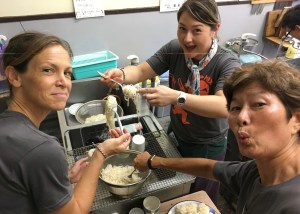
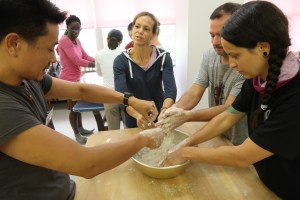
Leaving Ogi, we went to a soba noodle making workshop. I was teamed up with Yuta, Ilka, and Chiara. With a team like that (Team Racoon!) I figured our noodles would be awesome. The demonstration made it look suspiciously easy (but then again, the demonstrator had been making noodles for something like 30 years). Much like making bachi, making noodles was simple in theory and looked easy enough. There were many steps and as many chances to mess up but we had a lot of fun. We tooked turns getting messy and getting the noodles ready. Chiara was hilarious because she stuck her tongue out as she concentrated. Yuta turned out to be highly skilled with the knife; yielding it like a pro (I mostly made a mess and was teased by my teammates about the monstrous size of my noodles; they looked like udon noodles!). In the end, the noodles were very tasty (yes, we got to eat our creations!).

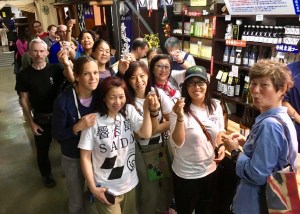
Following the soba meal we went to a sake distillery and had a short tour (consisting of a video) followed by tastings. Before coming to Japan I was not a fan of sake (I had tried it once and it was terrible). Earlier in the trip Daniel had convinced me to give it another try and I discovered that good, cold sake was quite enjoyable. By the end of the trip I was converted. Sadly, I did not buy a bottle at the distillery (it seemed a poor plan to carry a bottle for the next 2 weeks). There were so many kinds of sake, including the one served in first class on Air France. Chances of my flying first class with Air France (or with any airline for that matter)? Nil. But their sake was very good.


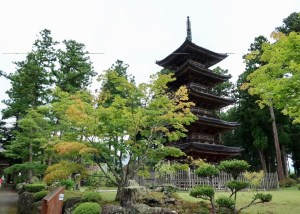
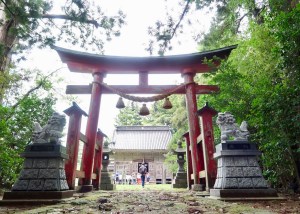
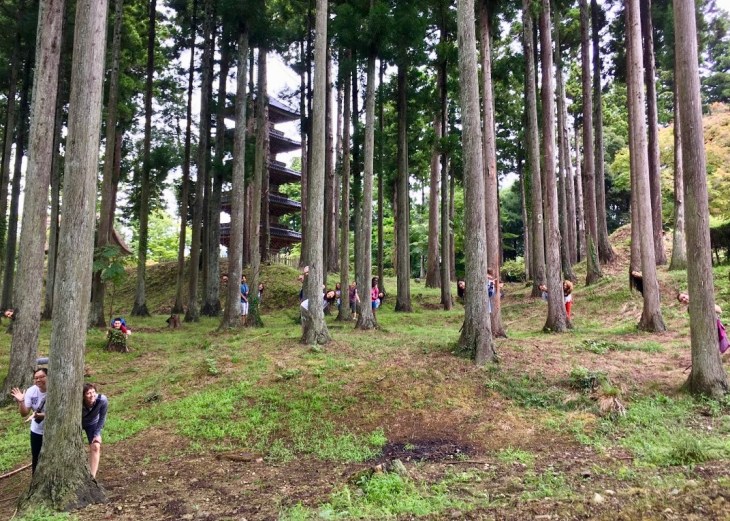
From the sake distillery we visited in rapid succession a temple (Miyosenji) and a shrine (Daizen). Atsushi explained the difference between the two (most simply: a shrine is a Shinto site; a temple is a Buddhist site.) He then discussed proper etiquette (such as : how to enter a temple, how to pray, the proper way to wash our hands and mouth, etc). The Japanese have a very relaxed attitude towards religion but it was nice to learn the traditions. Miyosenji temple had a five story pagoda and a small but beautiful garden. The nearby shrine was also the site of a Noh theatre stage, the oldest on Sado. Atsushi explained the highly codified and symbolic details of Noh theatre.
And what is a day without a visit to the Onsen? This time, it was in a luxury hotel. The onsen had baths indoors and outdoors (so we tried both). They were lovely. This time the hot bath was not as hot and the cold bath was not as cold. We idled the afternoon in bliss. We then made our way back to Ogi, where we had a special dinner in a fabulous restaurant (Yui’s favourite restaurant on Sado, and with reason). It was to be our last dinner with everybody. The meal was sumptuous and many toasts were raised (kampei!). Daniel bumped his head multiple times and I danced a fling.
Once back at the school, Atsushi produced some Frisbees and we had an impromptu Frisbee party. Atsushi had competed at the international level in his youth and it showed. He did some pretty crazy stunts with the Frisbee. In between Frisbee games we had a party in one of the classrooms. Having purchased an apron at the sake distillery Rhet played the role of waiter, to the amusement of everyone. Somebody (I forget who) started drawing on the chalkboard. This led to participants drawing their country’s map (with interesting results: Chiara’s Italy was the same size as the whole of the United States). I duly drew Canada, including the Rockies and arrows pointing to where it is mostly ice and snow (basically all of the northern half). Before too long the chalkboard was covered in drawings of countries, representing all participants, as well as various cartoons. It was that night that Yui demonstrated one of her secret talent (interlocking her toes with a volunteer). It looked as freaky as you imagine but it made everybody laugh. The revelry lasted longer than I did. In the early morning I woke up to use the lavatory and heard what I thought was the kitchen staff (turns out some of the participants pulled an all-nighter).
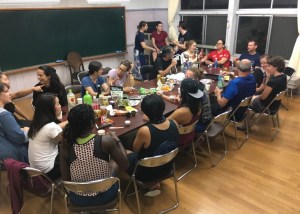

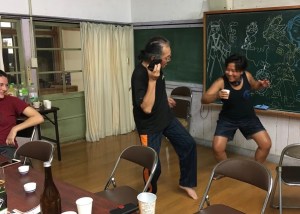


September 9th
The next morning some of us went to the sea, for one last view. It was raining a bit but it was a short walk through a lovely forest. The sea looked rough. It didn’t seem promising for the ferry crossing. Breakfast was delicious (thank you Okome-chan!!) Immediately after breakfast we had a lecture on Kodo by Atsushi. It was very interesting and I wished we had had it at the beginning. Kodo is a fascinating organization. In recent years Kodo has faced fierce competition by other taiko performance groups. Everybody agrees that Kodo performers have superior technical skills. In addition, Kodo also has the distinction of strong community spirit. Through their Cultural Foundation, they have greatly contributed to their surroundings to an extent no other group has (as far as I am aware).

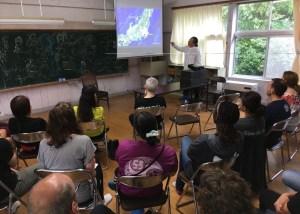
Just before lunch we left the schoolhouse to catch the ferry. Four of us (Lucy, Chiara, Ilka, and Diana) stayed behind with Yui because they were taking part in a pilot project : Roots of Kodo (ROK). They (along with two other non KASA Mixers) were going to spend a week at the Apprentice Centre, fully embedded. We said our goodbyes and then had a short wait before departure. There was a small shop so the Singapore Commando executed one final raid on Sado’s economy. Boarding went smoothly and there was an air of melancholy amongst the participants. But just as the ferry was leaving the Apprentices pulled one last trick. They showed up on the quay and started playing for us (and a few lucky ferry passengers), waving banners wildly. Our four volunteers for ROK were amongst them. We all lined up on the aft deck, vying for a good vantage point, enjoying our last moment with the Apprentices. I had my DSLR and snapped photo after photo. The camera made a convenient screen to hide the tears threatening to flow. Sadly, at some point I touched a button I shouldn’t have and from that moment on all my pictures were greatly overexposed (I only noticed once I was back home). True to form, the Apprentices played and waved and chased the ferry (as much as they could) beyond reason. We were far at sea and could not see them before they stopped. Even the Lipstick Boys made a special appearance, providing a comic interlude. Some ferry passengers joined us on deck and enjoyed the performance. Did they think this was a regular thing? The Apprentices even played my favourite Kodo tune : Irodori. Ahhh our Apprentices, how I miss them.
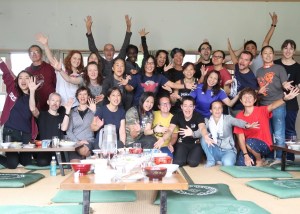

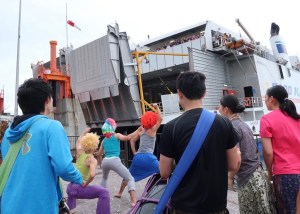

There was much melancholic reflection on the ferry. Thankfully the ride was smooth (despite earlier reports that the sea was fierce today). I sat near a young boy, in a special gurney, plugged to a medical machine of sorts. He was with his parents or caretakers, sleeping in visible discomfort. I stayed close because he was a reminder, if ever I should begin to feel sorry for myself, that things can always be worse and that we should be grateful, especially for our health. “There but for the grace of God, go I”, as a colleague used to say.
The ferry was followed by a bus, which we exchanged for a train until we reached Tokyo. From the train station we split into small groups and took taxis. Chizumi, who spoke native Japanese, convinced our taxi driver to make a small detour so we could take in some sights. As a result, if we were first to leave the station, we were last to arrive at the hotel and our fare was the most expensive. Sorry Yuta! We were staying at another Toyoko Inn and I was again pleased to learn we each had our own room.
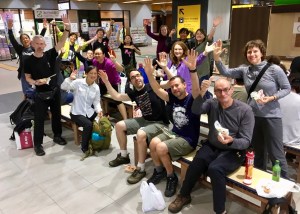
Dinner that night was at a wonderful restaurant (I forget the name). The food was exquisite and there was much cheer. It was our last dinner as KASA/MIX. Afterwards we spent some time at one of Yuta’s haunts (from when he used to live in Tokyo). There was a small drum kit set up and we took turns playing. On the way back to the hotel, we stopped at an arcade where we were delighted to find a series of taiko no tatsujin (like Guitar Hero but with a taiko drum instead of a guitar). We took turns playing (Lisa turned out to be a taiko no tatsujin shark which made me suspect she had one at home. Hmmm?). Rhet found a weird commuter train game where, as far we could figure out, he was the conductor and had to safely and quickly drive his train. He had no clue what to do (there was a very helpful character on screen giving him instructions and tips… in Japanese) and we found it hilarious nonetheless. After the arcade some returned to the hotel, others went on drinking. I went with Yuta and Ami to a noodle place (this was Yuta’s old neighbourhood so he knew all the ins and outs). There was a machine at the entrance where you selected your dish. It gave you a ticket, which you then exchange to the waitress for a delicious bowl. The noodles were amazing (my only regret is that, for some inexplicable reason, I decided to wear half of the content of my bowl on my shirt).


September 10th
The next morning we walked around, visiting Senso-ji (probably Japan’s most famous temple, and Tokyo’s oldest), and the neighbourhood of Asukasa. We had lunch at a noodle restaurant (Yuta’s recommendation). It was cheap and tasty. In the afternoon we visited Miyamoto’s shop, which included a drum museum. Dubbed “the noisiest museum in Tokyo”, it had drums from all over the world, ranging from hand-held to giant. The best part : you could play most of them. With about fifteen taiko enthusiasts let loose in the museum, you can imagine how noisy it became. The Caribbean steel drums were a favourite. Some of the drums were too precious (or fragile) to be played. They included an odaiko that was toured (and played) around Japan after the Fukushima disasters. The drum’s skins were covered in signatures and messages of solidarity.
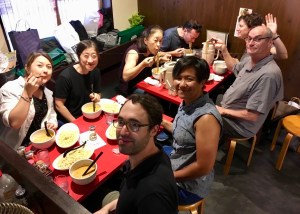
On the ground floor we raided Myamoto’s shop, spending a significant chunk of change (I know I did). Miyamoto was founded over 150 years ago and has made it part of its mission to promote traditional Japanese performance arts and festivals. While perhaps not as well known as Asano in North America, it makes high quality taiko and enjoys a solid reputation in Japan. Unlike Asano, it also makes portable shrines and traditional Japanese instruments. There was a showroom on the second floor and it was beautiful stuff.


The afternoon was spent shopping in Asukasa’s main trade street. It had mostly kitchen wares but also all sorts of shops (including an antique shop so cluttered that I beat a hasty retreat for fear of breaking (and buying) some expensive souvenir). Yuta had planned to buy the Apprentices a good kitchen knife. Apparently he had helped out in the kitchen and found the knife they were using worn out and of poor quality. We thought it was a splendid idea and all chipped in some money. We followed Yuta at Kamata’s to shop for a good knife. After inspecting the wares we found one we all agreed was the one. Yuta topped up the money and paid for the purchase. I bought the same knife (I had been so pleased and impressed by the food made by the Apprentices that I promised myself I would try and make better food at home. I reasoned that using the same knife as the Apprentices would help; it was sort of a kitchen spiritual connection. I will let you know how it turns out). While some of us were shopping, others had planned activities. Elaine, our Scottish representative, drove a Mario kart in the streets of Tokyo, wearing a Mario helmet. She brought back pictures and we had a good laugh.
In the evening we had an unexpected KASA/MIX bonus : Kabuki. It so happened that Kodo was collaborating on a special Kabuki project (Yugen, by Tamasaburo Bando). There was a performance that night and KASA/MIX participants were offered the opportunity to attend. I, along with most other participants, jumped at the chance. We made our way to the Kabukiza Theater, obtained translation tablets, and enjoyed the show. We had prime seats (at a discount price). The first act (which was unrelated to the next two acts) was fascinating. There were only two actors on stage. One played the role of a puppet, the other the role of puppeteer. The puppeteer stood behind the puppet and pretended to “play” him. The puppet in turn reacted to the pulls from the puppeteer and acted scenes. Since there were no actual strings, the two actors had to synchronize their movements to make it look real. Technically it must have been very difficult. The second act nearly put me to sleep. I’m sorry. I tried. I really tried. But it was really… slow… drama. Some in the crowd really got into it; I just fought to stay awake. At intermission, Yuta introduced us to his former sensei, a fine gentleman who looked younger than his age (maybe taiko really does keep you young). I bought a coca-cola to help stay awake. Thankfully the third act was the one most involving Kodo. If the second act nearly put me to sleep, the third saved me. It was amazing. It was actually based on three iconic Noh plays (the third one being the most spectacular however the first two were also mightily impressive). The sound, the colour, the movement, it was stunning. The addition of more drums (there must have been 20 or 30) made the play breathtaking. I left the theatre enchanted.
September 11th
Last day of KASA/MIX. Some are leaving today, others are staying in Japan for longer. I am part of the latter group. In fact, I have tickets for tonight’s baseball game between the Swallows and the Giants, a hometown rivalry. Some have already left by the time we gathered in the hotel’s lobby for a final farewell. It was nice to see my compadres one final time. I now understand previous KASA/MIX participants.
Epilogue
After KASA/MIX I spent another 12 wonderful days in Japan (Tokyo, Kyoto, Mastumoto, Nara, Takayama, Osaka). Eventually it was time to go home (I did briefly consider missing my flight). When I landed in Calgary, it was a cold (5 degrees!), rainy day. Japan had gotten me used to hot (30 degrees), humid, sunny days. Quite the shock. The leaves had already turned yellow and red. As it so happened, my return coincided with my taiko group’s first practice following our end of summer break. I had a nap and gamely showed up. I brought a few souvenirs to practice and performed a “show and tell” for a rapt audience. I talked about all the things I had seen and done. I talked about my fellow participants, the Apprentices, Kodo, Sado Island… In fact, I talked so much that I ended using up half the practice time. Nobody complained. I encouraged my taiko-mates to apply next time, and shared that KASA/MIX had to be lived to be understood.
Looking Back
Before I left for KASA Mix, I struggled to explain it to friends and family. The best I could come up was : it would be like if you were invited to a workshop with the Beatles. It’s a poor analogy but it’s the best I could come up with. I still don’t have a better explanation. If you are a taiko drummer or familiar with taiko, you “get” that a chance to study taiko with Kodo at Kodo’s Apprentice Centre is “kind of a big deal”. And it was. But for me, taiko became the pretext and background for the trip. This is why KASA/MIX is hard to explain. Yes, you participate in taiko workshops. Yes, you visit sights meaningful to the taiko community (like Kodo Village). But it was the connection to people that made the trip special. You get to meet taiko enthusiasts from all over the world. You get to spend 4 amazing days with the Apprentices. You get to be instructed by living legends of the taiko world, who were so enthusiastic and humble. You get a taste of Japanese culture and traditions. It was a very special trip; there are not many ways to explain it.
In hindsight, I would not have stayed in Japan after KASA/MIX. Or maybe just a day or two. The reason being that KASA/MIX was at times such an emotionally intense experience, I needed time to process it. In fact, during our sharing circle at the Apprentice Centre, I said just that : this will take time to process. Instead, as soon as KASA/MIX was over I moved on to the second part of my trip : travelling around Japan, which was an adventure in itself but very different. To be clear, I had a great time visiting Japan (highlights include the Fall sumo tournament in Tokyo, the baseball game, the food…). KASA/MIX and my trip around Japan were both amazing adventures. And I think I would have enjoyed both of them more if they had been separated by some time to reflect, that’s all.
I also would have packed differently. I “knew” it was going to be hot and humid. I don’t think I expected it to be that hot and humid and so consistently. I was ready for a typical Calgary Fall (some days are hot, some days are cold, it can be both hot and cold in the same day; be prepared for anything). Consequently, I had way too much cool weather clothes and not enough hot weather clothes.
In a weird, wonderful way, whenever I listen to Kodo’s Tomorrow my mind takes me back to KASA/MIX. Somehow it’s become intimately linked to my experience (probably because it was one of the background song to the KASA/MIX promotional video). It is a beautiful song that, in my mind, mixes joy and sadness (mostly joy), celebration and happiness.
Yui posted an account (and some photos) of the trip on Kodo’s blog page : https://www.kodo.or.jp/en/kodo_blog_en/staff_en/14584. Meanwhile, Diana published a short photo montage of ROK on youtube : https://www.youtube.com/watch?v=3yBT9VeiOr4.
My two favourite quotes from the trip :
My favourite vegetable is water. (Yui)
Yuta is always right. (Yuta)
Special Thanks
Paula, without whom my taiko journey would never have begun;
Donna, our point of contact at Kodo Arts Sphere America, who very patiently answered all my questions and provided tips and instructions;
Yui who so good-naturedly tolerated my mischief, documented our trip, and was a constant pleasure to be around;
Yuta who guided us through KASA/MIX, led some of the mischief, and was like a brother;
Marty (the current Artistic Director for Midnigh Taiko) who kindly introduced me to katsugi during a taiko hour meant for volunteers;
Diana who took my teasing in stride (and then flipped it right back at me) and was kind enough to check my draft for mistakes (when I asked, her response was, and I quote, “You’re inviting me to judge you? YES PLEASE.”);
All my fellow KASA Mixers, who made this trip unforgettable;
The Apprentices, thank you so much; I wish you health, happiness, success.
All photo credits : Yui Kawamoto and Yuta Kato
Where are they now?
Abena came back home to Washington and opened a chain of onsen (421 locations and counting!)
Lee moved to Toronto… then back to Korea, then moved to London, Berlin, Manilla, Paris, Washington, Moose Jaw (Saskatchewan), Pittsburgh, and finally, back to Toronto.
Ami opened a bar on Sado Island and eventually offered a waiting job to Rhet
Annie, Jane, Irene, Jo, Jennifer founded a retail empire and made millions until a visiting Saudi prince took their motto “Shop till you drop” a little too literally.
Chizumi became a professional typhoon chaser and starred in two National Geographic documentaries.
Daniel bumped his head on a low ceiling one time too many while visiting a set of Lord of the Rings. His last words were “!@#&!*!*! Hobbits!!”
Elaine became a professional race car driver. Her car had a very cool but poorly aerodynamic Mario Bros design.
Fanny went to Spain, studied Gaudi, and finally tried natto (she did not like it).
Kelly was last seen still trying to remember the highland fling.
Laetitia became a world famous paparazzi after selling her photos of Ken Watanabe sleeping on a plane (she thought it was Yuta).
Lisa became a professional taiko no Tatsujin player, winning the world cup seven years in a row. She finally moved out of Baltimore.
Lucy became a marathon runner until she realized she did not actually like running.
Pat opened a chopstick-making shop in LA. She’s now a mutli-millionaire.
Richard made his way through Asia minor on his bike and is now the town crier in Perth.
Rhet made millions suing Justin Bieber for using his signature dance move without permission, and then lost it all investing in “micro-bachi”. He now waits tables at Ami’s bar.
Chiara and Ilka joined forces to open a “taiko school by day, soba restaurant by night, karaoke bar on weekends”.
Diana finally beat Kelly at something (a game of rock, paper, scissor).
Yui became President and CEO of Kodo but still guides KASA Mix groups.
Yuta moved back to Hachijo, married a former Miss Hachijo, fathered 9 children and now spends his weekends between Walmart and Costo wondering “What the hell happened??”
All the Apprentices became successful members of Kodo, except Ryo, who won a gold medal for Japan in track and field at the 2020 Olympics. He now lives off the royalties from his participation in a Nike advertisement campaign (“I hate running, which is why I only wear Nike shoes”.)

 A Taiko Blog